New Era in Space Exploration Must Emphasize Safety, Quality Control
By Matthew Beddingfield and George Leopold

NASA Inspector General Paul K. Martin didn’t mince words during a recent House Science Committee hearing titled, "Keeping Our Sights on Mars Part 3: A Status Update and Review of NASA’s Artemis Initiative.”
During the March 1 hearing, Martin made clear that the cost of the four Artemis missions wouldn’t be sustainable and didn’t hold back when critiquing the contractor’s work thus far.
"One of the problems we saw in development of the SLS and Orion, it's a challenging development of course, but we did notice very poor contractor performance on Boeing's part, poor planning and poor execution," Martin said.
These comments not only raise concerns about the affordability and future of the program, but also bring to the surface the long and often complicated relationship that NASA has had with contractors in the past.
As NASA continues its voyage into a new era of space exploration, one that increasingly relies on private companies to bring projects to fruition, the agency mustn’t forget this fraught history and the tragedies that paradoxically paved the way toward later success.
The string of recent space spectaculars have certainly been worthy of celebration, but the goals that NASA and its commercial partners have set for themselves will continue to deal in human lives, and the two parties again find themselves at a crossroads where the unending effort to ensure crew safety must remain a top priority.
These stakes were described in stark terms by NASA officials during the space agency’s most recent “Day of Remembrance” honoring two shuttle crews and the astronauts lost in the Apollo 1 fire.
“Human mistakes caused those accidents,” said NASA Administrator Bill Nelson. “There’s always risk. You have to balance that risk with safety.” Nelson’s memories of the 1986 Challenger accident are perhaps even more visceral than others: the former U.S. senator flew on the shuttle mission immediately before the Challenger accident.
The question then becomes, how can the events of the past be woven into both the agency’s culture of safety, as well as contractors’?
NASA has its own processes for escalating safety concerns, as well as its panel of aerospace safety advisors, but having the processes in place doesn’t always equate to a true culture of safety and quality control.
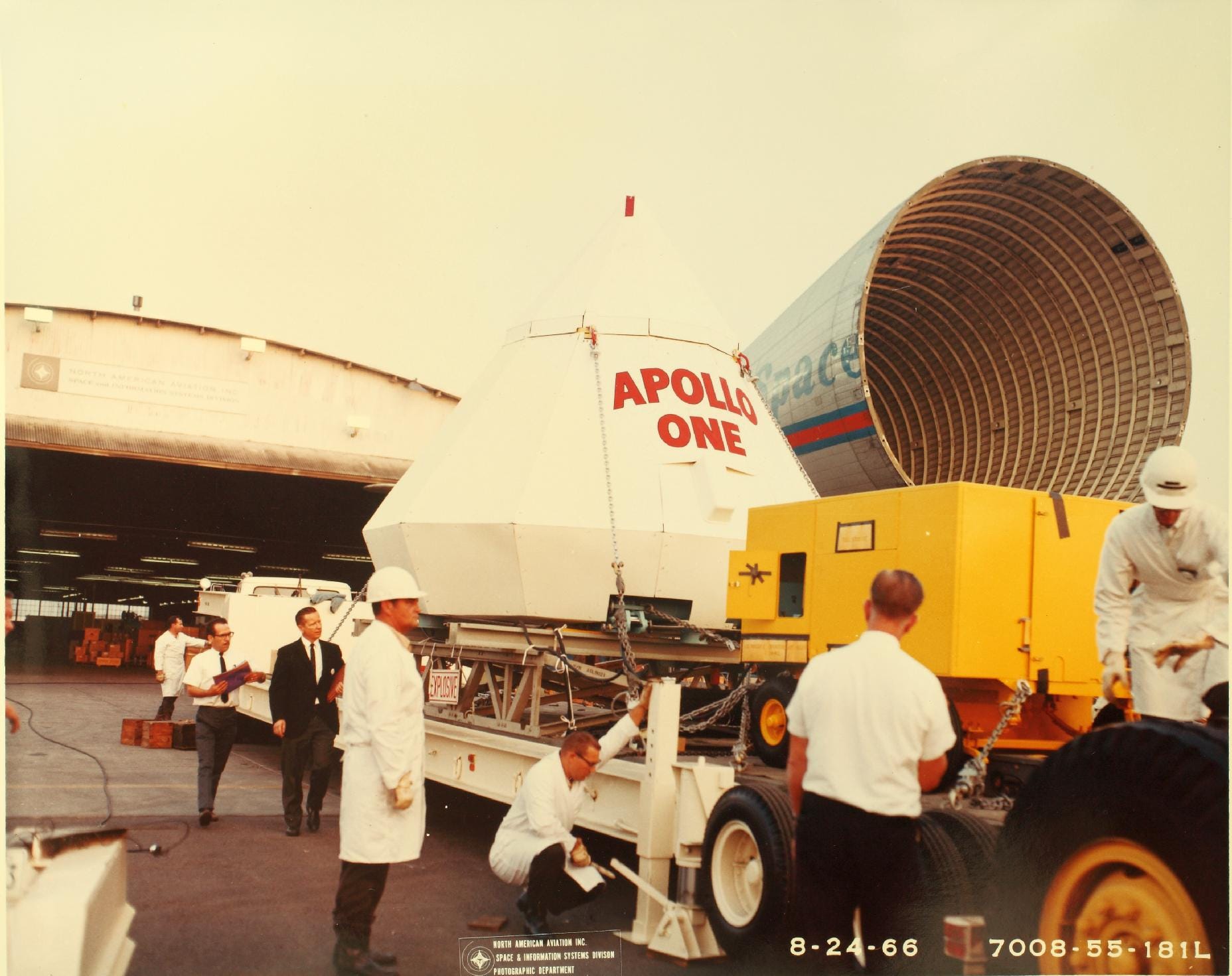
James Gleaves, the mechanical lead technician for North American Aviation, came face to face with death when he was in the White Room during the Apollo 1 fire. Gleaves recalls that safety was a top priority during his time working on the command and service module, and that elevating concerns wasn’t necessarily an issue.
Despite these facts, the Apollo 204 project ultimately led to one of the greatest tragedies in NASA history. As was the case in other space exploration tragedies, there were voices in the room that weren’t acknowledged as they should have been. A flat hierarchy of opinion that allows all voiced concerns to be addressed is a pivotal step that NASA must utilize itself and demand from its partners.
There’s no denying that NASA has worked to consistently improve its approach to safety and quality control, but the tough questions need to be asked on a daily basis so that the idea of quality control and safety goes beyond the process and into the day-to-day culture.
Today it seems as if a generational shift is driving NASA’s recent efforts to double down on crew safety. Urged on by former NASA flight controllers, the space agency’s current leadership is seeking to move beyond merely remembering the Apollo 1, Challenger and 2002 Columbia disasters. The emphasis now is applying the bitter lessons learned to ensure crew safety in the next largely commercial phase of what remains an inherently risky enterprise.
The flight of Columbia, designated STS-107, was the first for then-director of flight operations Robert Cabana. The former shuttle commander and NASA’s associate administrator is blunt: “I don’t ever want to go through another Columbia,” Cabana said during a recent agency self-assessment.
Cabana notes a changing of the guard within NASA. The U.S. space agency is entering a new and risky phase, relying on commercial space companies to design and build new spacecraft along with a giant booster intended to take humans back to the moon.
From the Apollo 1 fire in 1967 to the Challenger accident in 1986, Cabana noted the similar gaps in time between the Apollo 1 and Challenger tragedies, compared to the Columbia accident and present day.
“We’ve had a huge turnover in our personnel. We have new people, we have different people in leadership positions. I don’t want to forget the lessons learned from the past,” Cabana said, adding that the agency is in a time of great change as it works on a new spacecraft.
“I don’t want to see us complacent ….We have to pay attention all the time,” he said.
This renewed emphasis on crew safety is driven in part by recent aviation disasters, as documented in the recent Netflix documentary, Downfall: The Case Against Boeing, and the failure of Boeing’s Starliner spacecraft to reach the International Space Station during its un-crewed maiden flight in December 2020.
In that specific case, it ultimately fell to NASA engineers to trace the failure’s cause to a faulty orbital insertion burn. Starliner has yet to fly again.
By contrast, Boeing’s chief competitor SpaceX has undergone stringent NASA software code audits. So far, Elon Musk’s space venture boasts a nearly perfect safety record. But, as Apollo 1 Commander Gus Grissom acknowledged, the longer you’re on the flight line, the greater the odds you can “buy the farm.”
Upcoming missions are planning extremely risky operations like a spacewalk from a SpaceX Dragon spacecraft. That would require depressurizing the Dragon crew compartment, exposing all inside to the vacuum of space. Given the lengths to which NASA trains ISS astronauts for repair EVAs, the proposed spacewalk seems an unnecessary risk.
An accident in Earth orbit also would also test the resilience of the SpaceX business model.
Soon or later, as Grissom noted, astronauts will be killed. Space exploration remains extremely risky. NASA’s renewed emphasis on testing, training, redundancy—vigilance—are among the only ways to minimize those inherent risks.
Looking back to the tragedy of Apollo 1, the warnings signs had been there. General Sam Phillips, who at the time was the Apollo Program Director, was tapped to investigate the work of North American Aviation, the contractor developing and manufacturing the command and service module. Phillips’ assessment, later known as The Phillips Report, was grim, claiming that North American’s performance “is characterized by continued failure to meet committed schedule dates with required technical performance and within costs.”
Comparing Martin’s recent comments regarding the Artemis program wouldn’t necessarily be fair, but it still stands as a stark reminder of what could happen when these types of assessments are not addressed in proper fashion.
During the “Day of Remembrance,” Cabana described NASA’s approach to crew safety this way: “Our decisions have consequences. Everyone needs to be listened to, not [just] heard…. That’s how you get the best data to make informed decisions.”
Strict adherence to Cabana’s safety pledge, and a consistent reminder of the mantra that “complacency kills,” will go a long way toward reducing the risks associated with human spaceflight.
Refusing to compromise in the never-ending road to a “perfect” approach to safety, while applying the lessons learned from Apollo 1, Challenger, and Columbia, is the best way to honor the memory of 17 astronauts who paid the ultimate price for human mistakes.
---------------
Matthew Beddingfield is a writer and attorney based in Washington, D.C. He is the grandson of James Gleaves, the last remaining survivor from the scene of the Apollo 1 tragedy. George Leopold is the author of Calculated Risk: The Supersonic Life and Times of Gus Grissom.
As an Accident an Incident Investigator for 19 years in the airline industry, I was taught that there is a chain of events that produce an accident. If you can remove a link, you could prevent the accident from occurring. After investigating hundreds of incidents, I decided to focus on getting the correct information to pilots faster. I even came up with a prototype in 1997 when we were switching from paper to electronic manuals.
I was wondering if you have found if there was a chain of events that lead to the Apollo 1 and if any of the events were linked to systems knowledge. I am assuming that the radio communications issue would have been one of these links that could have been broken to prevent the accident, but I am not sure.